
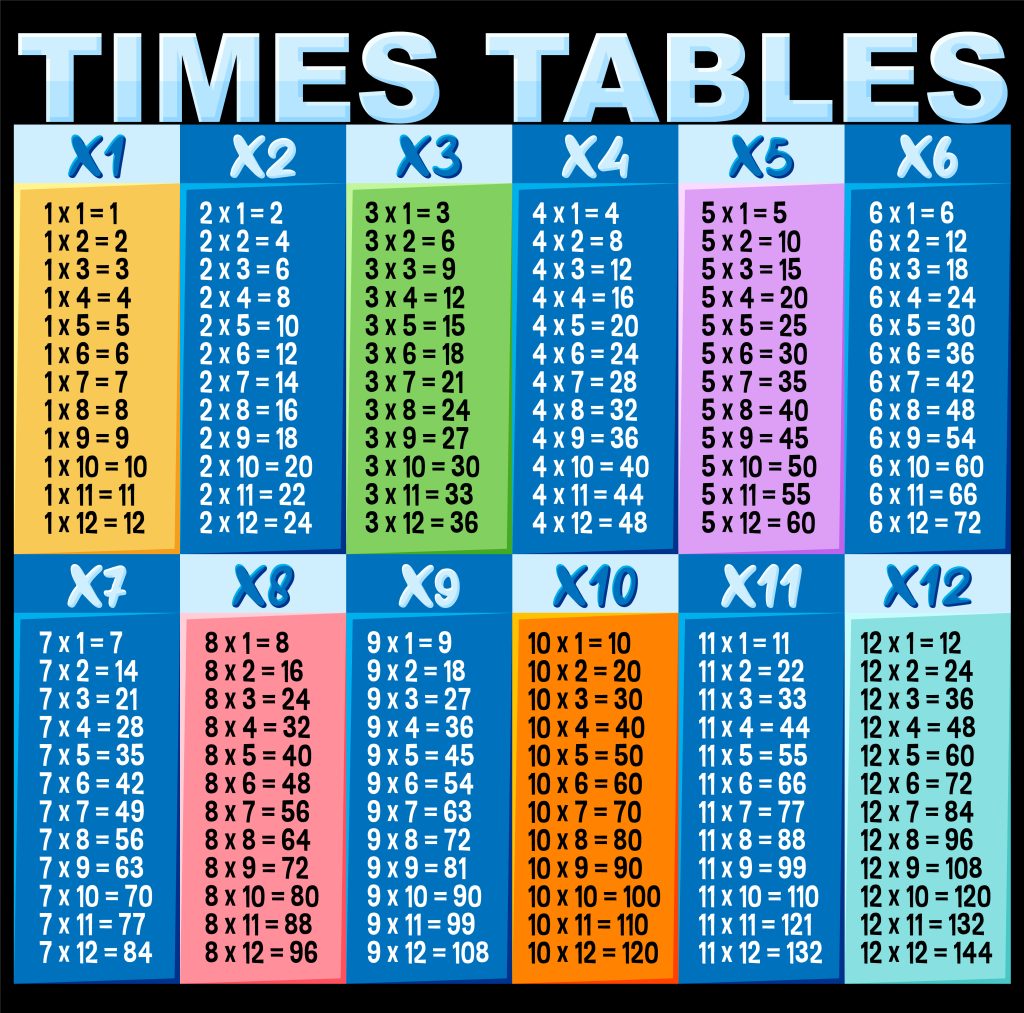
The best way to learn multiplication is to understand the concept.
You need to know that 2s: Double the number.
5s: Always end in 0 or 5.
9s: The digits of the product add up to 9 (e.g., 9 x 7 = 63; 6 + 3 = 9).
10s: Simple patterns ending in 0.
Start with the easiest tables first (1s, 2s, 5s, and 10s), before moving to the harder ones like (3s, 4s, 9s) then practice the more challenging ones (6s, 7s, 8s) last.
Learn the easiest tables first (1s, 2s, 5s, 10s), then move to harder ones like (3s, 4s, and 9s), leaving the most challenging ones (6s, 7s, 8s) for last.
You should also understand that 9 x 3 = 27, is the same thing as 3 x 9 = 27
To build up speed, you need to start practicing counting numbers (2, 4, 6, 8, 10…)
| 1 | 2 | 3 | 4 | 5 | 6 | 7 | 8 | 9 | 10 | 11 | 12 | |
| 1 | 1 | 2 | 3 | 4 | 5 | 6 | 7 | 8 | 9 | 10 | 11 | 12 |
| 2 | 2 | 4 | 6 | 8 | 10 | 12 | 14 | 16 | 18 | 20 | 22 | 24 |
| 3 | 3 | 6 | 9 | 12 | 15 | 18 | 21 | 24 | 27 | 30 | 33 | 36 |
| 4 | 4 | 8 | 12 | 16 | 20 | 24 | 28 | 32 | 36 | 40 | 44 | 48 |
| 5 | 5 | 10 | 15 | 20 | 25 | 30 | 35 | 40 | 45 | 50 | 55 | 60 |
| 6 | 6 | 12 | 18 | 24 | 30 | 36 | 42 | 48 | 54 | 60 | 66 | 72 |
| 7 | 7 | 14 | 21 | 28 | 35 | 42 | 49 | 56 | 63 | 70 | 77 | 84 |
| 8 | 8 | 16 | 24 | 32 | 40 | 48 | 56 | 64 | 72 | 80 | 88 | 96 |
| 9 | 9 | 18 | 27 | 36 | 45 | 54 | 63 | 72 | 81 | 90 | 99 | 108 |
| 10 | 10 | 20 | 30 | 40 | 50 | 60 | 70 | 80 | 90 | 100 | 110 | 120 |
| 11 | 11 | 22 | 33 | 44 | 55 | 66 | 77 | 88 | 99 | 110 | 121 | 132 |
| 12 | 12 | 24 | 36 | 48 | 60 | 72 | 84 | 96 | 108 | 120 | 132 | 144 |
When you understand the 1x, 2x, and 5x tables, you are good to go for the rest.
For instance, when you understand that:
Anything multiplied by 1 is equal to that same number. eg.. 1 x 1 = 1, 1 x 9 = 9, 1 x 11 = 11.
Anything multiplied by 2 is equal to that number in 2 places. eg. 2 x 4 = (2 + 2 + 2 + 2 = 8).
2 x 7 = 14.
Understanding The 3x Table
You can easily get what 3x will be by understanding what the result of the number you want to add to it is in the 2x table, then add that result to the number itself.
eg.. 3 x 4 = ?
To get 3 x 4, once you know 2 x 4 = 8 then you will add 8 + 3 = 12 (3 in 4 places 3 x 4 = 12),
2 x 7 = 14 then 14 + 7 = 21 (7 in 3 places 7 x 3 = 21),
Understanding The 4x Table
The 4x table is different. When you know what the result of the number you want to add to it is in the 2x table, just add it by that same number again, and then you get the result in the 4x table.
eg., 4 x 4 = ?
(2 x 4 = 8, then 8 + 8 = 16). That gives you the answer 4 x 4 = 16.
4 x 9 = ?
(2 x 9 = 18, then 18 + 18 = 36}. That gives you the answer 4 x 4 = 16
Understanding The 5x Table
As stated earlier, 5s always end in 0 or 5, and it begins with 1, and it repeats the number immediately after, and ends with 5, before moving to the next number in an ascending manner. Let’s use our 2x formula again with this.
eg., 5 x 2
(5 + 5 = 10, or 2 x 5 = 10 is the same thing as 5 x 2 = 10)
5 x 3 = ?
(5 + 5 + 5 = 15. That gives you the answer 5 x 3 = 15)
You can see that the example above started with 1, and ended with 0, then the following number also started with 1, then ends with 5, as aforementioned. Since a number has repeated itself, it is time to go to the next number.
5 x 4 = ?
(5 + 5 + 5 + 5 = 20. That gives you the answer 5 x 4 = 25).
Or you can use the 4 formula.
(2 x 4 = 8, then remember the 4x formula that when you multiply a number by 2, you add the result with 4, to get your answer. So 2 x 4 = 8. 8 x 2 = 16 + 4 = 20. 20 + 5 = 25). That gives you the answer 5 x 4 = 25
Proudly brought to you by TeachersAroundMe.com